
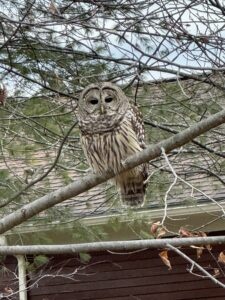
Wake Robin is home to many species of birds and a great number of bird aficionados. Each winter and spring, residents take part in the annual Great Backyard Bird Count, launched in 1998 by the Cornell Lab of Ornithology and the National Audubon Society.
Their eBird site features data gathered by state-of-the-art statistical models and machine learning to build visualizations and tools to better understand migration, abundance patterns, range boundaries, and much more. The eBird Team compiles raw data and high-resolution satellite imagery from NASA, NOAA, and other sources to produce cutting-edge statistical models to predict when, where, and in what numbers species occur every week of the year.
This is very high-tech stuff, but it starts with real people, on the ground, counting and identifying the birds they see in a given timeframe. From Friday, February 13 through Monday the 16th, a group of Wake Robin residents kept their eyes and ears tuned to the avian world. They noted time, place, species, and how many birds they saw. The information is compiled on a document and submitted to eBird. This is the “raw data” that goes into building the statistical models.
The Wake Robin observers submitted 53 checklists logging 21 species with counts of each. They try to make the counts as accurate as possible, but some have to be estimated. How do you count starlings? The most prevalent species were the ones you probably see in your own backyard: European Starling, Dark-Eyed Junco, American Goldfinch, Black-capped Chickadee, three species of woodpecker, and 14 more. Some birds really get around…chickadees showed up on 31 lists.
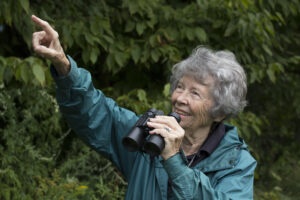
Resident Ken O. heads up the Great Backyard Bird Count and says: “These sightings represent winter-resident birds on our campus. In May, we do a similar count to record the summer bird population.” We’ll be back in a few months with another scorecard.