Category

Blog

Wake Robin Connects

By | Blog

It feels like life is an endless series of screens. It is difficult to break away from the digital world. On the other hand, it offers amazing opportunities for special connections. We asked a few Wake Robin residents how they use their internet pipelines to engage the world.

Geri A. gives talks to healthcare organizations on the various human aspects of healthcare such as disclosure of unanticipated outcomes, apology, communicating with angry people, informed consent, and the like. She regularly hosts virtual classes for UVM’s Olli program, and, for personal growth, Geri participates as a student in a series of classes in Buddhism being taught by a lama in Nepal.

Also pursuing peace of mind is Lucy B. who has been practicing daily meditation for 50 years! For the last 5 years, she has led a weekly international group of 25 regulars, half US/Canada, half UK, and one from Latvia. As a member of her international Christian meditation community, she also creates and runs its US national website, and manages its national Zoom platform.

Some professions have an international scope and digital communications are the key to making that possible. Bernie R. is a conductor who has worked with orchestras all over the world. He has a strong connection with classical musicians in Cuba and recently mentored a conducting student, living in Sweden, who is working to be accepted into a graduate program at the Royal Academy in London. From his home at Wake Robin, Bernie can help with the analysis of the score and critique technique, from Shelburne to Malmö!

We sometimes get asked, “How robust is the Wake Robin internet service?” It seems to be good enough to connect to the world!

Sugaring at Wake Robin

By | Blog

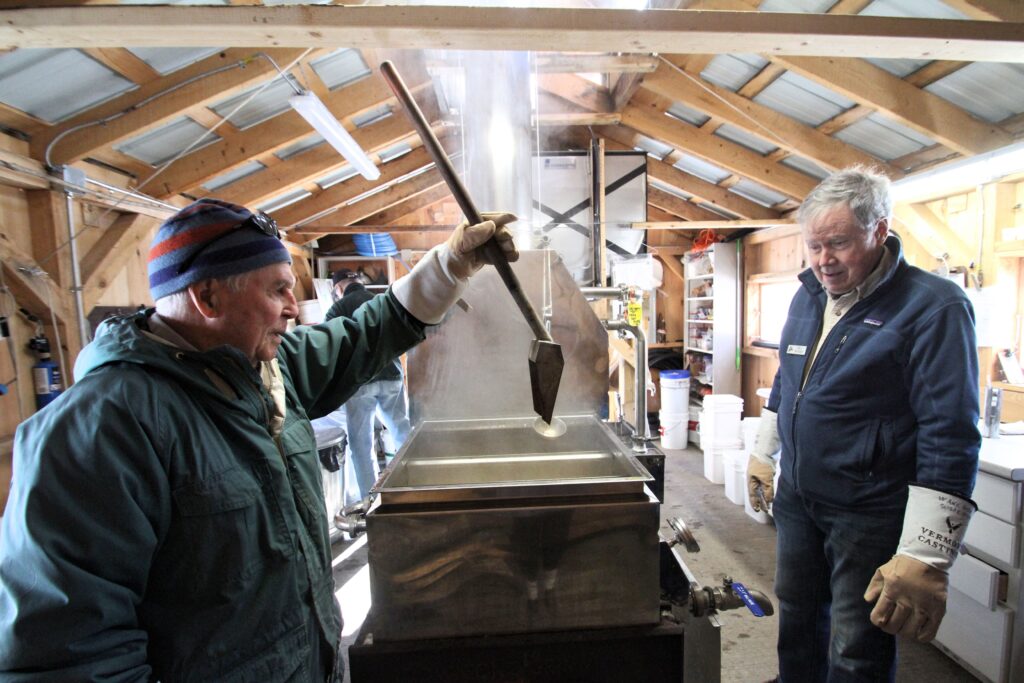
It used to be that one of the major signs of spring in Vermont was the running of maple tree sap signaling the start of the sugaring season. Mother Nature has changed up her game in recent years and now the sap runs almost anytime from December through March.

John B. reports that the sugaring team at Wake Robin began collecting sap last December and they seem to be looking at a bumper-crop year. The sugar house at Wake Robin has a 300-gallon holding tank that has been full to the brim for the past several weeks. Resident volunteers take shifts to boil the sap transforming it into the glorious amber liquid we all love – Vermont-made maple syrup. The crew had a record day on March 3 when they drew off seven and a half gallons of Amber Rich. At a ratio of 40 gallons of sap to 1 gallon of syrup, that’s a lot of boiling! Last week, total production crossed the 50-gallon mark.

Wake Robin maple syrup is allotted to the workers who make it, and some is designated for Dining Services where it is the main attraction at the annual Pancake Breakfast and Maple Ice Cream Social. The syrup is part of the welcome basket for new residents and is sometimes given as an honorarium to guest speakers.

We all see the picturesque, bright, and steamy sugarhouse with sap at full boil, but once the sap stops running and the syrup is bottled, there is plenty more to do. The task list for the off-season is extensive. There is the major cleanup of buckets and evaporating equipment, shifting wood to fill the woodshed for next season, doing maintenance and repair on the sap lines damaged by squirrels and wind, rinsing the lines twice during the year, and taking care of the numerous little things that show up during the season. According to John, “I’m happy to say that we do have a large and faithful group of Sugar Makers.”

Maple sugaring at Wake Robin is a rite of spring, a labor of love, and the rewards are very sweet!

The Wood Shop at Wake Robin: Well Beyond Wood!

By | Blog

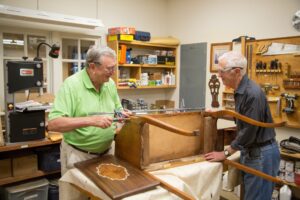
Residents of Wake Robin know that the Woodshop has a work order system. They will do repairs to furniture and assorted odd jobs. How odd? We asked Jim W. to tell us about some of the projects brought to them. Yes, they get the usual wobbly chair legs or a refinishing request but then it goes well beyond wood. “We’ve fixed a toaster, a pedometer, a bicycle, clocks, porcelain, and assembled plastic shelving. We cut down the handle of a toilet brush to make it the right size…actually that was wood,” Jim told us.

 

In addition to personal pursuits such as bowl turning, shelves, cabinets, and even a boat, the woodshop gang has also taken on commissions. Their work is in use at Sneakers restaurant, the UVM Book Nook, and Shelburne’s Pierson Library. Several of their pieces are on display around Wake Robin, too: the table outside the Meeting Room, the Humanities Committee cabinet next to the stairs, and the iconic icosahedron hanging over the main desk in the lobby…a 20-sided figure created to celebrate the 20th anniversary of Wake Robin.


The Woodshop has a binder of their projects, a fun photo history of people and the work they have done. There are several photos documenting the journey of a particular tree that fell during Hurricane Irene in 2011. It was a large maple that Bob W. sawed into logs, and a flatbed carried it to Shelburne Farms where it was dried and milled into lumber. Those planks came to be stored at 35 Crabapple, and they are now in the shop as stock for new projects. The circle of life of one Wake Robin tree.

The Wood Shop at Wake Robin is here to do a repair, help you learn a new skill, or just make some new friends.

New Year’s Resolutions at Wake Robin

By | Blog

If you think the idea of making a New Year’s Resolution has been around for a while, you’re right! We can trace it back to the Babylonians over 4,000 years ago. A common resolution then was to return borrowed farm equipment. The ancient romans ran with the idea as did medieval knights with the “peacock vow.” Americans in the early 1900s took a spiritual tack on self-improvement resolutions such as “build a stronger moral character,” or “develop more restraint in the face of earthly pleasures.”  Today, we have our own take on making positive changes in our lives.

Not surprisingly, the majority of responses were “I don’t make resolutions!” but some people still make the effort. Jo-Ann B. offered this: “My resolutions EVERY year are to be kind, stay healthy, be physically active, and engaged with life as a Vermonter, American, and world citizen.  The pleasure and privilege of another year to me are indeed a blessing and a gift.  As for sticking with these broad resolutions, I persevere and persist and remember that humor and a good laugh every day always help.”

Another realistic approach came from Candace P. “Hah! Every year I fail to get my Christmas letter to friends and family written and sent before Christmas. So, my New Year’s resolution is often to send a New Year’s letter in January. I fail more often than I succeed. If I’m lucky, my friends receive a Valentine’s letter instead!”

Kayaking at Wake Robin

By | Blog

Written by John S., Wake Robin Resident

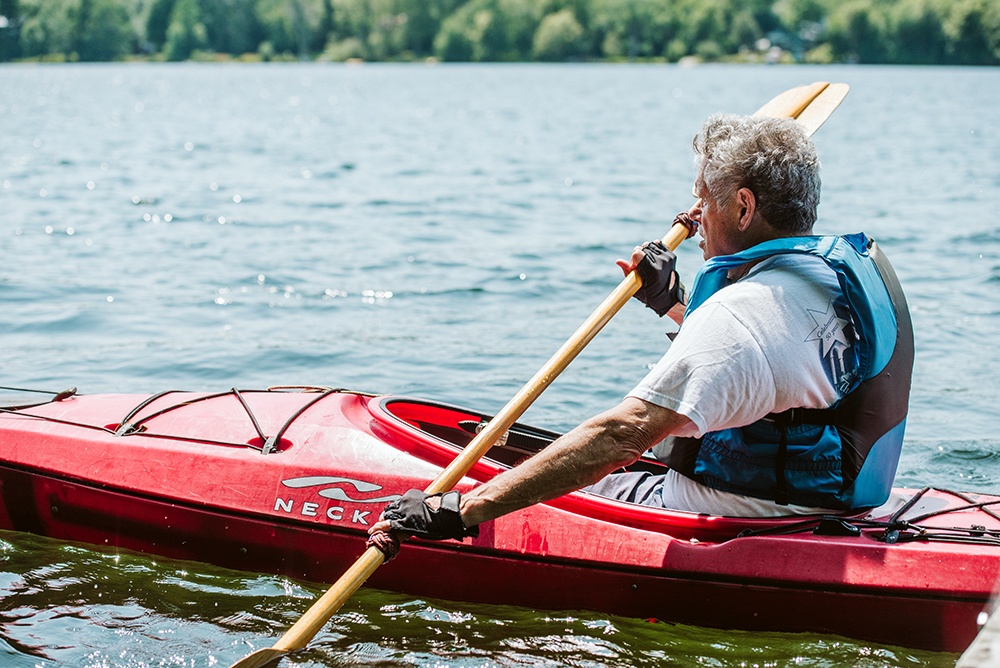
Wake Robin has really awakened to the joys of kayaking. With Lake Champlain literally at its feet and the sport was given a boost by the popularity of new, super lightweight (15 lbs.) Hornbeck kayaks, there are now at least two dozen Wake Robin kayakers on our lakes, rivers, and ponds. For an early morning paddle, you can put in at neighboring Shelburne Beach or nearby Bay Road fishing access and check out the coves accessing the broad lake of Lake Champlain.

There is the delight of winding your way up the totally protected waters of the La Platte River, a mecca for birders during the spring migration. A variety of sites – Waterbury Reservoir, the Lamoille and Winooski Rivers, and numerous stunning lake coves are within forty-five minutes of the Wake Robin campus.

Some of us try to get out whenever the weather permits, and go to different places two or three times a week. Some like to go early in the morning and see snowy egrets, cormorants, herons, turtles, and other wildlife in the placid waters of the La Platte.

Although kayakers have been on the Winooski River with its mild rapids, most of the paddling is on rivers or lake bays and inlets where the wind does not whip up disturbingly large waves. The Wake Robin paddlers are not into daredevil kayak racing or fast-moving waters. They prefer the calm paddling that most of our waters provide so they can enjoy the health benefits of leisurely, relaxing paddles and observing nature rather than marathon adventures.

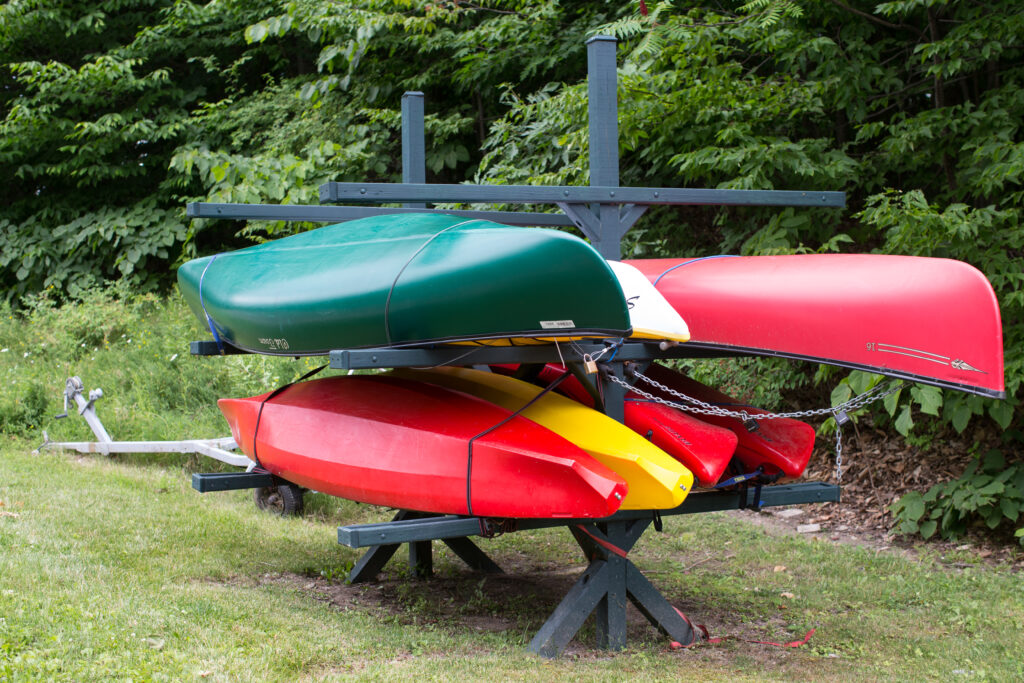
Those who have the light Hornbeck kayaks usually keep these watercraft in their garages to avoid the effects of UV light. Several others store them on the very popular outside kayak rack… which is full at the moment. Since the outside rack is consistently full, we are considering building another (with the help of the woodshop crew).

Kayaking residents have such an enjoyable time on the water taking in all that nature has to offer. We would be happy to welcome any new resident kayakers and share with you your favorite kayaking spots.

The History of the Welsh Garden

By | Blog

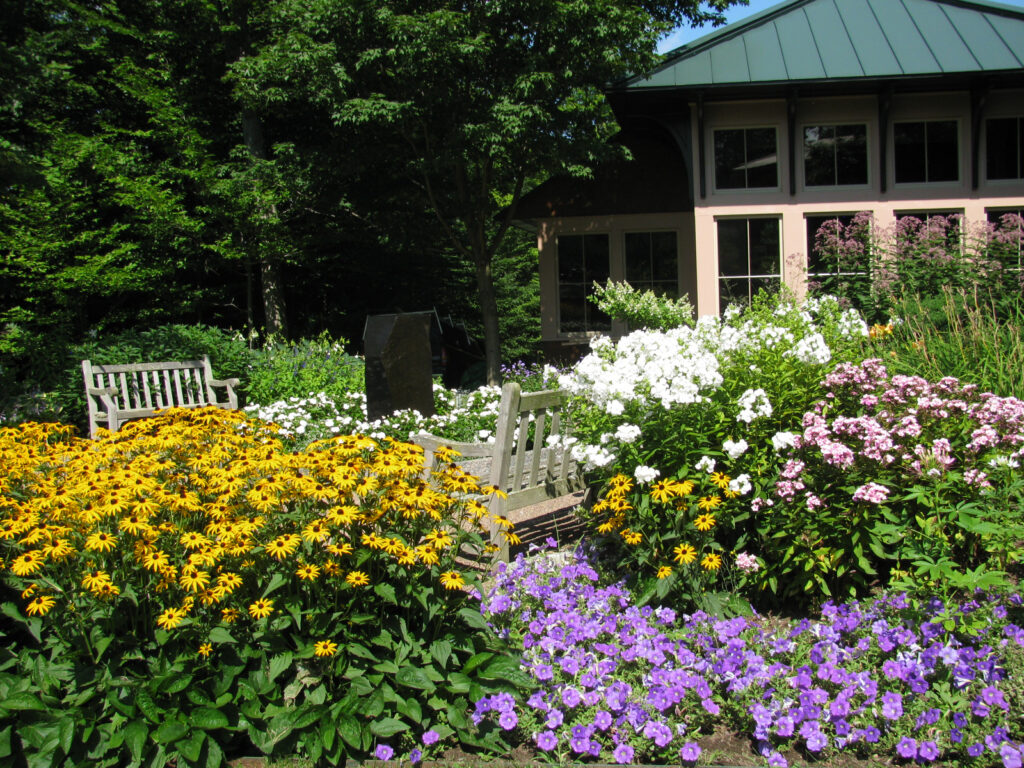
The Welsh Garden at Wake Robin has seemingly always been a fixture of Wake Robin’s landscape. It is situated on the back lawn, next to the Aquatic Center. During the last phase of renovation, there was much effort put in to protect the space from harm. This garden is not just meant to be beautiful or to be a space of reflection; it was built as a testament to a former resident.

The garden is named for Priscilla Welsh. She was well known in the community through her involvement with Planned Parenthood, Civil Liberties Union, the Unitarian Church, and as a partner in By-Gone Books. She was also well known for her love of flowers. She especially loved nurturing flowers around Wake Robin to beautify the public spaces for everyone. When she passed unexpectedly, one of her friends decided that there could be no better tribute than a beautiful space filled with flowers, shrubs, and benches.

When this area was created in 1999 – flowers and shrubs were transplanted from Welsh’s personal garden, as well as from the gardens of her family members. The centerpiece of this space is a stone fountain that circulates water as it passes through the irrigation system, keeping nearby plants watered.

Since its creation, there have been a few minor changes, mostly to make the space more accessible for those with walkers and wheelchairs.

This Wake Robin landmark remains today as a reminder to stop to smell the flowers. A magnificent gift to remember someone who was very loved and who appreciated upholding the beauty of Wake Robin.

The History of the Jean Connor Library

By | Blog

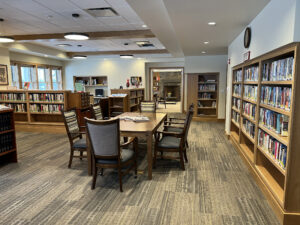
The Jean Connor Library has gone through quite a few transitions through its existence at Wake Robin. It began with a basket containing a few books available for residents to borrow. It has now evolved into a library with over 4,000 volumes, 1,000 DVDs, and audiobooks.

A haven for all book lovers at Wake Robin, the library is named after one of the community’s first residents, Jean Connor. A librarian for 30 years before retiring, Connor was dedicated to the organization and functionality of the space. The library currently operates with about 25 resident volunteers and it’s their dedication that ensures the offerings are always evolving and growing. “It’s a big job with tracking returns, organizing shelves, overlooking donations, and considering new purchases,” says Pat D, the head librarian.  “While there is always a constant stream of donations from residents, there are also many new volumes per month added to the collection.”

The most recent transformation occurred during the renovation of the Community Center finishing in 2020. This construction created space for the addition of 750-1000 more books as well as enlarged areas for reading tables and comfy chairs. Resident committees such as the Nature Committee and the Racial Justice Committee were granted dedicated shelf space to house special topics.  A few shelves of children’s books await grandchildren of residents (these books are not usually expected to return).
Scheduled hours?  7 days a week, 365 days a year! If the Community Center is open, the library is also open for business.  Even through Covid, avid readers were offered their favorites by way of curbside pick-up.  Gratefully, the doors are once again open for all to enjoy this special place.


From the Wake Robin Archives…

By | Blog

Article from Newsletter “News from Wake Robin” dated Fall, 1997.

What’s in a name?

by Cathy Y.

Naturalist and Wake Robin Founder

How did the name of Wake Robin–and the names of the many buildings in our community come to be? When the Founding Committee arrived at the decision that, indeed, there was to be a Life Care Community, they gave the naming responsibility to an ad hoc committee. Doro S., Fran A., Mary G., and I (all nature lovers) met, selected and finally proposed Wake Robin for its overall name, with the buildings to be named for a long list of our native trees. Linden, an important honey-producer (and another name for Basswood) was the last building to be named. For the cottages and apartments, we chose names of trees or bushes which grow on Wake Robin’s hillside or nearby.

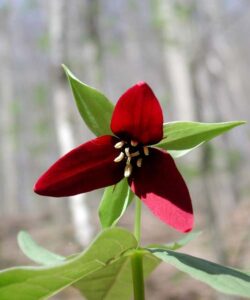
Red Trillium and Wake Robin are identified now as one plant, but in the early days, settlers in Appalachia called all its family Wake Robins; there was the Large White, Dwarf White, the lovely Painted (at higher elevations) and the shy Nodding and small Toad Trilliums (The Latin word triplum or triple, is the base for Trillium with its three leaves, three petals, and three stamens). All varieties are found in Vermont, but at different elevations and in different habitats with the common Red and White (also named the Snow Trillium) the earliest to bloom.

The Red Trillium is synonymous now in my wildflower references to Wake Robin and it carries unfortunate nicknames–Birthroot, and Indian Balm (it was once used to stop bleeding externally and on snakebites) and also Wet Dog Flower and Stinking Benjamin referring to its odor. But because it and its lovely white relative are our most visible tenacious (their rhyzomes spread through rock walls and over forest floors) and beautiful reminders that spring has come again, the new beginnings and successful lives of the residents moving to this new facility seemed appropriated to correspond. Our nature-oriented committee felt that the bond between people and plants was indeed a strong one — with the carpets of Trillium, white and red, the name Wake Robin, could carry the message of spring throughout the year.


A Little Art Museum at Wake Robin: The Gentry Gallery

By | Blog

If you’re new to the community, the Gentry Gallery is a pleasant surprise to discover. It resides in the Community Center hallway north of the Maple Leaf dining room and serves as sort of an “art museum” bridge to the Linden Health Center. It’s a common sight to see a resident, and at times family or friends, stop right in their tracks because of a moving piece of work. Exhibits have ranged from quilt showings, wood carvings, photography, oil paintings, and watercolors. Most displays have been completed by Wake Robin residents.

The west side of the gallery offers a long stretch of wall, approximately 117 feet, to hang artwork, and that space comes in handy as it allows for large frames and canvasses. Across the hall, the showcase shelves are backlit and contain fascinating artifacts made up of resident collections. With 80 square feet available, past collections have featured a wide range of artisan pottery and tools from early American history. Currently the showcase shelves illustrate the history of the automobile with exquisitely made miniature models from the Ford Model T to the Thunderbird.
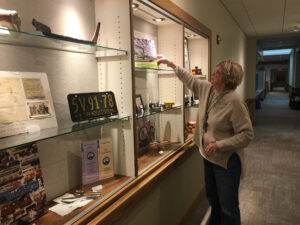
Setting up the exhibit

The gallery of artwork is curated by members of the Gentry Gallery committee. Often, they partner with resident artists who either have professionally exhibited work or have practiced their craft for several years. The showcase shelves are of a democratic variety: topics are announced to the community and then residents contribute items that match that theme. Themes are intentionally general so residents can get creative. About half a year ago, the theme was set to transportation, and the shelves featured a model sailboat, a black and white picture of a resident’s grandfather on a horse buggy, and someone’s running shoe. The Gentry Gallery committee labels each item, so residents know who brought in what, with amusing conversations usually ensuing from what was seen on the showcase shelves.

Next time you’re in the Community Center, make sure you to stop by and enjoy the art atmosphere created by the Gentry Gallery and its exhibits!

Resident Guest Blog: Battling Buckthorn

By | Blog

Battling Buckthorn

By Candace Page

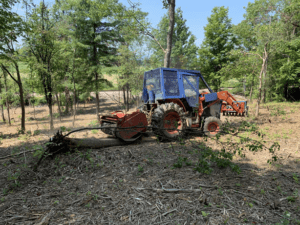
A tearing, grinding hullabaloo arose as Gerry Hawkes drove his tractor into a seemingly impenetrable patch of common buckthorn below the Maple apartments one morning in August. The first phase of a long-term plan to reclaim nearly 13 acres of Wake Robin forest from the grip of invasive underbrush was nearing completion. The big, wedge-like teeth on the 2,500-pound shredder attached to the tractor’s back end ripped at the buckthorn. Rotating knives swallowed the small trees and spit them out in shreds. The machine drove deeper into the jungle, leaving behind a carpet of woody mulch.

“When I started here in 1992, this was all native forest with open areas of grass,” grounds manager Peter Hausermann explained as he surveyed the area from the third floor of Maple. That didn’t last: Buckthorn was on the march.

Common buckthorn is a vigorous, tree-like shrub, a European native imported to the United States as an ornamental in the 19th century. Like many invasives, it escaped from gardens into the wild and . . . went wild. Buckthorn leafs out early, creating shade and monopolizing nutrients so that native shrubs and saplings can’t compete. Its blue-black berries contain a natural laxative that makes them a poor food source for birds, who nevertheless spread the seeds. 

“By 2005, the density of buckthorn down here was at the point you couldn’t walk through it,” Peter remembered. By 2021, it was difficult to see the few remaining large oaks, butternut, and ash in the woods; the jungle was a poor habitat for birds and wildlife.

But what to do? Removing buckthorn (and its sidekick, invasive honeysuckle) in any quantity is nearly impossible to accomplish by hand. “I’ve never seen anything like its root system,” Peter said. “It’s incredibly strong and tolerates any condition.” Though he had wanted to attack the problem for years, he had found no feasible method.

Then Wake Robin’s consulting forester, Joe Nelson, learned of Gerry Hawkes and his firm, Forest Savers. A Woodstock contractor and tinkerer, Gerry had turned his tractor into an assault force for clearing invasives in places where native trees need to be spared. “All of a sudden we saw the opportunity in the cheapest way possible to achieve something you can’t do manually,” Peter said.

Over many days this summer, Gerry and his tractor worked their way through 12.5 acres of woods in Wake Robin’s southwest corner. His machinery—debris rake on the tractor’s front, cutter/shredder on the back—cut down the invasives and chewed up everything, while leaving desirable trees untouched. (Much of the green and white ash went too, since those trees are doomed by the arrival of the emerald ash borer.)

Now, Joe Nelson said, there’s a chance for a different kind of woodland to thrive. Audubon Vermont’s Mark LaBarr, who also consulted on the project, said he hopes a variety of native shrubs will join the small clumps of native, fruit- bearing hawthorn left behind by the clearing work. Gray-stem and red-osier dogwood and viburnum, for example, “are great for pollinators, and they produce a great supply of berries in late summer and fall,” Mark said. Shrubland dwellers like gray catbirds and eastern towhees may be drawn to the area. “And we’d love to see blue-winged warblers and golden-winged warblers.” Joe and Mark will work with Wake Robin this winter to devise a master plan to guide future management of the woods.

If Wake Robin can succeed in preventing the resurgence of buckthorn and honeysuckle, the woodland between Maple and the railroad tracks will become a mosaic of native trees, grassy areas, and shrubs. That will require ongoing work for at least the next three to five years. The land will need to be mowed and brush-hogged to cut down the invasives that sprout from seeds and roots left behind by this summer’s work.

County forester Ethan Tapper visited the site and was impressed by what he saw, though he warned, “It’s the follow-up that will determine whether this is a success…there is so much buckthorn in the Champlain Valley that the threat will always be there.” He added that Wake Robin residents shouldn’t expect the cleared area to become a neat and pretty landscape. Not all the remaining trees will survive the change in their environment, and the brushy habitat attractive to birds can look messy to human eyes.