All Posts By

Wake Robin

What Did You Have for Dinner June 13th?

By | Blog

If you were one of the lucky residents of Wake Robin, you were seated for an amazing tasting menu of seafood dishes and complementary dessert. This was the second in a series of special meals our kitchen staff has created to flex their culinary muscles and have some fun.

Interested parties signed up and a randomizing program selected 40 diners for this experience. The lead chef for the evening was Josh Krechel who designed the tapas-style menu working closely with our seafood supplier out of Boston Harbor. They had a lead time of two and a half months to work out the theme partly based on fish migration and what is at peak season in early June. Josh explained there is much more to consider than simply what to cook. This involved the geography of food, in this case, ocean locations and seasons, where the fish are, and what would make a good combination for a sequence of courses.

Josh favors the New York City style of plating that arranges food by vertical design
pile it up! He was also designing by color and chose bright accents such as a strawberry gazpacho, beet root gravlax, and yellow romesco sauce. The featured seafood included lobster, scallops, gravlax (cured salmon), octopus, and sea bass.

After the bounty of the sea came a stunning dessert created by Deborah Stearns, Wake Robin’s pastry chef. She has been part of the Wake Robin kitchen team for 20 years and says these tasting menus are a chance “to do the fun stuff!” Coordinating with Josh on the visual aspect of each course, she was free to come up with something that would be the conclusion of this feast. Deborah chose to work with the classic flavor combination of goat cheese, pear and wine to build her Chevre Panna Cotta with Wine Poached Pear. But she needed one more component to finish it off. She quickly learned how to do “spherification” and turned raspberry jelly into “caviar.” Deborah loves the art of baking, but food science really interests her. “I’m a science geek” she said as she explained how she made food into spheres for the final accent on her dessert.

The tasting menus come up every couple of months with a lot of anticipation from our residents. For the Dining Services team, food is more than cooking to provide sustenance. Food is a science and a joy for the chefs of Wake Robin.

How Playing Pickleball is Enriching the Lives of Seniors

By | News


Pickleball is one of the fastest-growing sports, particularly for active seniors. I spoke to a man named Peter Galbraith who is an avid player. He lives in Wake Robin, a senior life plan community in Shelburne, Vermont.

Peter believes that playing pickleball can save America and I believe him. It has so many benefits for active seniors and here is why, according to him.

Peter played tennis most of his life and has been playing pickleball for over 6 years as an early adopter.  He and many of his 400 neighbors have been playing at Wake Robin perfecting their skills and competing against each other.

Pickleball, as a sport, has been spreading across the country at a rate of 200% in the past few years.

As a person who has never played pickleball, I asked Peter to tell me how it is played and the benefits for people over 50.

During the pandemic, the parking lot of Wake Robin was empty, so residents set up a portable pickleball net. Four years later about 10% of the community is playing pickleball with only two who had played before.

Peter says the game is referred to as “dangerously easy to learn.” The reason is you become addicted to playing it.

One of his neighbors is a 92-year-old woman who wears a knee brace, and the other residents have to be careful challenging her to a game because she usually wins.

The health benefits for seniors of this aerobic exercise include improving flexibility and balance.

As in any sport, there is always a risk of injury. Peter recommends before taking up any sport, check with your doctor first.  It helps to do other exercises and stretching before attempting to play.

Peter has seen extraordinary success with pickleball in his community and the world.

One of the biggest benefits for seniors is the social aspect of playing pickleball. Socialization is a key factor in longevity. Because the residents play with people of all ages and all points of view, it binds them together in friendship.

A headline in The New Yorker reads, “Can Pickleball Save America.” The point is that when people get out there and have fun it nurtures relationships and quells conflicts.

Pickleball is now seen on tennis channels, “much to the distress of tennis players.”


Pickleball can be played at many different levels

Peter has been a tennis player all his life. He says that if you are playing tennis with someone new to the sport, it isn’t a lot of fun. But in pickleball, players can pick it up quickly making it an interesting and competitive game.

The court is small, unlike tennis, so it doesn’t require that you run all over it. The average age of residents at Wake Robin is 83 so most players shuffle rather than run around the court.  The rules of pickleball are designed to take the power out of the game so it’s easy for anyone to play.

7 feet of space next to the net on each side is called “the kitchen.” You can’t go in the kitchen unless the ball bounces there. That means you can’t stand at the net and slam the ball. Behind that 7-foot area is a 15-foot area where most of the playing is done. 90% of pickleball is played with doubles. It can be played with singles but is more fun and less exerting with more players.

Tournaments at Wake Robin are round robin where everyone plays with and against everyone else in a series of short games. This limits the time spent on the court.

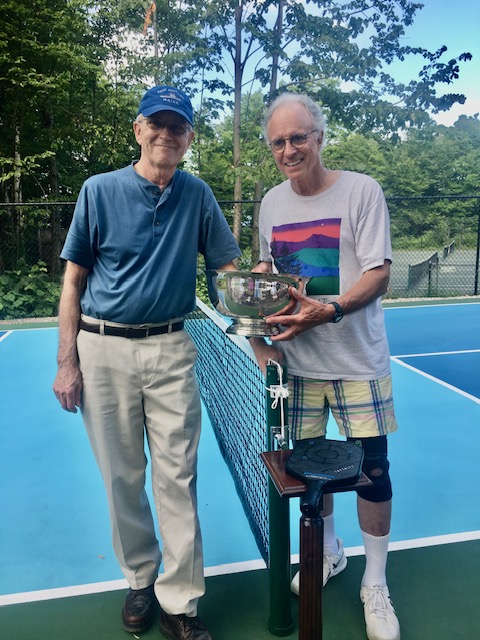
Peter Galbraith and friend winning at pickleball
Peter Galbraith (left) and friend winning at pickleball.


Pickleball is played with a lightweight ball with holes made of plastic. The holes slow down the ball, making it easier for seniors to play the game.

Outdoor pickleball is usually played on concrete that has been coated to make the surface softer. Peter recommends wearing classic-style tennis shoes that do not stick to the ground instead of running shoes to prevent injuries. Indoor courts generally have wood floors.

The paddle is small, about the same size as a racquetball racquet, made of wood or carbon materials.

A pickleball game usually lasts about 11 minutes.

Beginners should not back up too fast while playing to prevent falling.

Many tennis facilities put pickleball lines on tennis courts so people can play either game.

At the end of our interview, Peter quoted the poet Horace. (25 BC)
“Mix a little foolishness with your prudence. It is good to be silly at the right moment.”

How Senior Care Communities Can Keep Dining Menus Fresh and Exciting

By | News

By Paige Cerulli | iAdvance Senior Care | Posted June 17, 2024 | Article Link 

Meals are a very important part of the senior care experience, but it’s easy for dining menus to become repetitive. Fresh and varied menus enhance resident satisfaction and enjoyment while also promoting better nutrition and wellness. I Advance Senior Care spoke with three experts about practical ways senior care communities can keep dining menus fresh and exciting.

The Value of Menu Variety

Lindsay Scaringella, MS, RN, LDN at CareOne, explains that menu variety is important for several reasons. “Most importantly, as we age, our nutritional needs become more individualized to our chronic health conditions. It is important that our diets align with the right macro and micronutrients,” she explains. For example, diets low in sodium are important for those with heart conditions. “Providing a variety of meals that are less processed and focus on whole foods is key to managing a healthy lifestyle and reducing health complications,” Scaringella says.

Goodwin Living’s Culinary Innovation & Development Chef, Brian Patterson, notes that menu item and ingredient variety can be mentally, emotionally, and intellectually stimulating and satiating. “Variety can also refer to where ingredients are sourced,” he notes. “More and more, residents take an interest in where their food comes from. The narrative behind food is increasingly relevant to how we enjoy and care about what we eat. We welcome farmers and wine makers to our campuses to give presentations and tastings, and we are planning field trips to local farms, breweries, and wineries.”

Patterson explains that he’s also seen increased resident desire for greater cultural diversity through culinary experiences. This includes ingredients and techniques tied directly to authentic styles of cuisine, as well as more immersive dining experiences like chef’s table and wine dinners.

Strategies to Offer Menu Variety While Staying Within Budget

To offer variety while staying within budget, Patterson encourages senior care communities to adopt several strategies. “Working with broadline vendors to source bulk deals on sensibly raised, processed, and packaged foods is one way of getting the best deal,” he says. “Pair more expensive items with ingredients that cost less to achieve a well-priced meal or offer them with an upcharge to the regular dining allowance or cycle menus.”

Local purveyors can also help communities stay within budget. “Demand for locally sourced food can lead to developing relationships with local purveyors who can offer potential for savings by dealing directly with local producers that feature uniquely local ingredients,” says Patterson. “Consider working pop-up experiences into your menu schedule, which makes it possible to serve up special experiences and foods like a Hawaiian Luau, Spanish Tapas, Asian Noodle House, German Wurst and Beer Garden.”

Kate Hays

Kate Hays, director of dining services at Wake Robin

Kate Hays, director of dining services at Wake Robin, says that the community creates menu variety by running a daily menu as well as an “always available” menu with plenty of extra offerings and choices. “Our daily menu offers a soup and appetizer du jour, a choice of two animal-based and one plant-based entrees, a starch and vegetable du jour, and a dessert du jour,” she says. The always available menu includes a vegetarian soup, a choice of additional salads, entrĂ©es, vegetables, and starch. “We also offer unseasoned griddled chicken, salmon, and tofu for those looking to avoid added sodium or address other health or nutritional issues, or who are just unhappy with the daily menu offerings. To create additional menu choices, residents are invited to use a sauce off one of the daily entrees to customize their unseasoned protein of choice if they desire,” Hays notes.

Scaringella explains that the CareOne food service team collaborates to create a varied menu while staying within budget. “Buying foods within season is a great way to save money while getting the best tasting produce,” she says.

She notes that it’s also important to focus on limiting food waste to maximize the food budget. “Educating staff to encourage patient food intake and keeping record of meals that are a ‘hit’ can help reduce waste and save money.”

How to Establish a Dialogue Between Residents and Culinary Services

Resident input is an essential element in creating menu variety, and there are many ways to capture that input. “In addition to emails and hallway conversations with residents, Wake Robin has comment boxes in our dining rooms, a Suggestions and Concerns Committee, a resident council meeting that addresses dining issues, and a Dining Advisory Group,” says Hays. She notes that the channels give residents a chance to share their thoughts and engage with the culinary team.

CareOne in Newton, Massachusetts, holds quarterly resident counsel meetings with the activity group. Residents have the chance to provide input on what they might want to see on the menu during the coming months. “Getting positive and negative feedback from the residents can help reduce food waste and save money within the food service budget,” Scaringella says.

Patterson notes that residents are very involved in informing Goodwin Living community menu choices. Campuses encourage resident input in several ways:

  • Recipe contests in which residents submit recipes and the chefs choose their favorites and feature them on the menus, along with the narrative or story behind the recipe.
  • Residents often bring herbs and vegetables from their garden boxes to the chefs.
  • Cooking demonstrations and hands-on cooking classes stimulate resident input.
  • Chefs and residents dine together. This is a great way for chefs to receive input and understand the aspirations of residents.
  • The life enrichment team sponsors Culinary Passport Trips, monthly outings to local restaurants that are driven by resident requests and preferences.
  • Goodwin Living hosts celebrity bartender nights that feature a team member or resident and their preferred cocktail.

Additionally, Goodwin Living encourages dialog between dining services and residents with tools including direct engagement, a comment book in each venue, survey cards, and an email forum for open discussion.

Strategies for Incorporating Seasonal and Local Ingredients Into Menus

Patterson encourages senior care communities to research the farms in their area, then reach out and develop relationships. “We visit local farms and invite farmers and producers to our campuses to lecture and present tastings,” he says. “Food can taste better when it’s local, and it makes us feel good about our food choices.”

Hays notes that Wake Robin has established relationships with about 40 local farm partners. “By purchasing readily available items locally we are paying a fair, not inflated price and it is also a better practice from a sustainability standpoint — better for our residents and staffs’ health, better for the local economy and our bottom dollar, and better for our carbon footprint,” she says.

Additionally, Wake Robin hosts summer farmers markets from late May through September. The dining team samples an ingredient weekly, educating residents and staff on how and why to introduce healthy, whole foods into their diets. “Dining has hosted programming focusing on culinary medicine and mindful eating, an educational and nutritional approach to improving eating behaviors relating to nutrition, exercise and movement, mindfulness, and health coaching,” explains Hays. “Food can affect how we feel, support mental focus, fuel performance, and can prevent and treat many chronic diseases.” By creating varied menus, senior care communities can support resident wellness in all of these ways.

Quilt of Valor Donated to Wake Robin

By | Blog

We have observed one more Memorial Day and what better time to tell you about a recent donation from resident Peter Maytham. Peter currently serves as the president of the Wake Robin Residents’ Association and is a vintage car buff. He served in the U.S. Navy aboard the John Paul Jones in the mid-1950s, and after many years of service, retired as a Commander. In 2018, Peter was awarded a Quilt of Valor while attending a reunion with his shipmates in Tennessee.

His award reads:

United States Navy Atlantic and Mediterranean 1955-1985

On behalf of the Quilts of Valor Foundation

In recognition of your service for this nation

It is a privilege to serve honor and comfort upon you

Though we may never know the depth of your sacrifice to protect

And defend the United States of America

As an expression of gratitude

From a grateful nation

We award you this Quilt of Valor

19th day of August 2018 in Franklin, Tennessee

Previous enewsletters had stories about the Trillium Trail Quilt, an in-house honor bestowed on Wake Robin residents as they make their final exit from our community. Peter’s donation of his Quilt of Valor is meant to share the honor and gratitude with all Wake Robin residents who have served. There are over 60 veterans living on our campus with 20 living in the Linden Health Center. He says he “hopes to bring comfort to their families in the same way the Trillium Trail quilt has honored other residents.”

The Jean Connor Library

By | Blog

Much of the information we read comes to us on various screens
computers, tablets, e-readers, even phones. The residents and staff of Wake Robin still treasure the experience of holding a real book with a sturdy library binding and protective cover. Whatever the content, a book has substance and weight. It is a comfortable tactile experience.

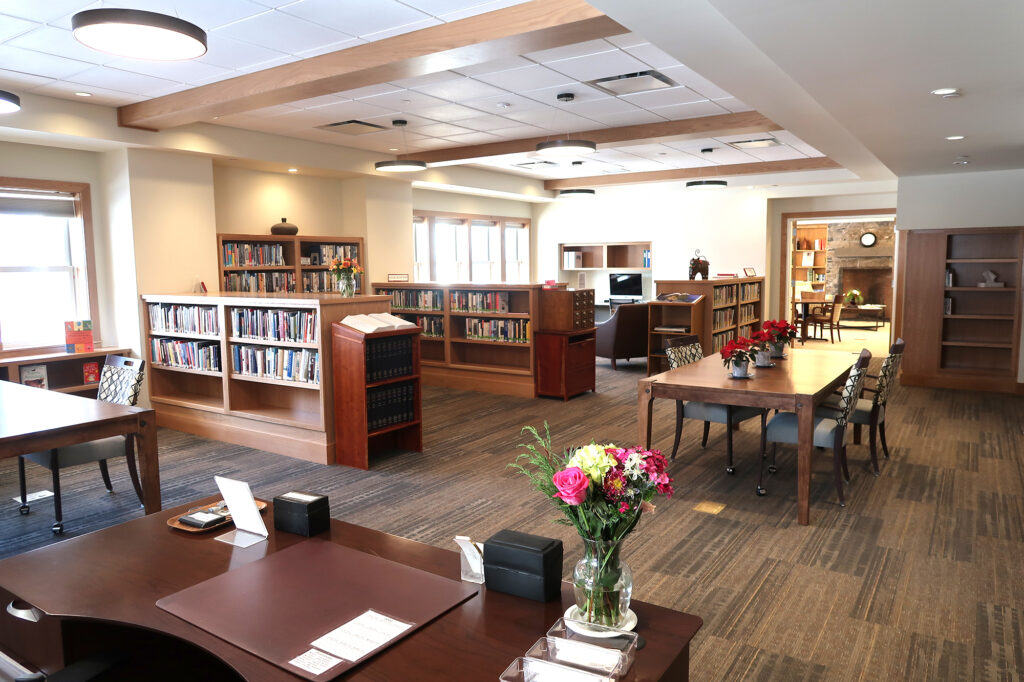
The library at Wake Robin is named after one of the original residents, Jean Connor. She got her degree in Library Sciences from Columbia University and had a career in the state library system of New York. Jean was the natural choice when it came to starting the collection at Wake Robin. In the early days, the “library” was a couple of boxes of books to lend and share. The collection has grown substantially and is housed in a beautiful, airy room with an adjacent lounge in the Community Center. There are extension libraries in the Butternut lounge and the Balsam neighborhood of the Linden Health Center.

Today, the Jean Connor Library contains about 5,000 general interest books with 200 new titles added each year. It is managed by 17 resident volunteers who take care of the day-to-day tasks of making entries to the database, returning books to the shelves, putting covers on new acquisitions, labelling the spine, and, yes, even creating cards for the card catalog!

In addition to the books, there are daily newspapers (NY Times, Burlington Free Press), a reference section, large dictionary, atlas, magnifying reader, and dozens of periodical titles.

Jean lived at Wake Robin for nearly 30 years and left us at the age of 102. She got to witness the growth of her library and left us all a legacy we can enjoy every day.

The Dining Advisory Group introduces Potluck Seating

By | Blog


There are many ways for residents to take part in life at Wake Robin. There are dozens of activity groups and committees, options to serve on boards – the Wake Robin Resident Association and Wake Robin corporate – or sometimes serve as advisors for various aspects of resident life.

The Dining Advisory Group (DAG) provides input on the food and dining experience. They are the conduit for information between dining management and residents. For example, Kate Hays, Director of Dining, will send out satisfaction surveys and communicate the results to the DAG. Two issues now up for discussion are the reservation system and vegetarian options. The Group will talk through those issues, perhaps come up with action steps, and report to the population at large.

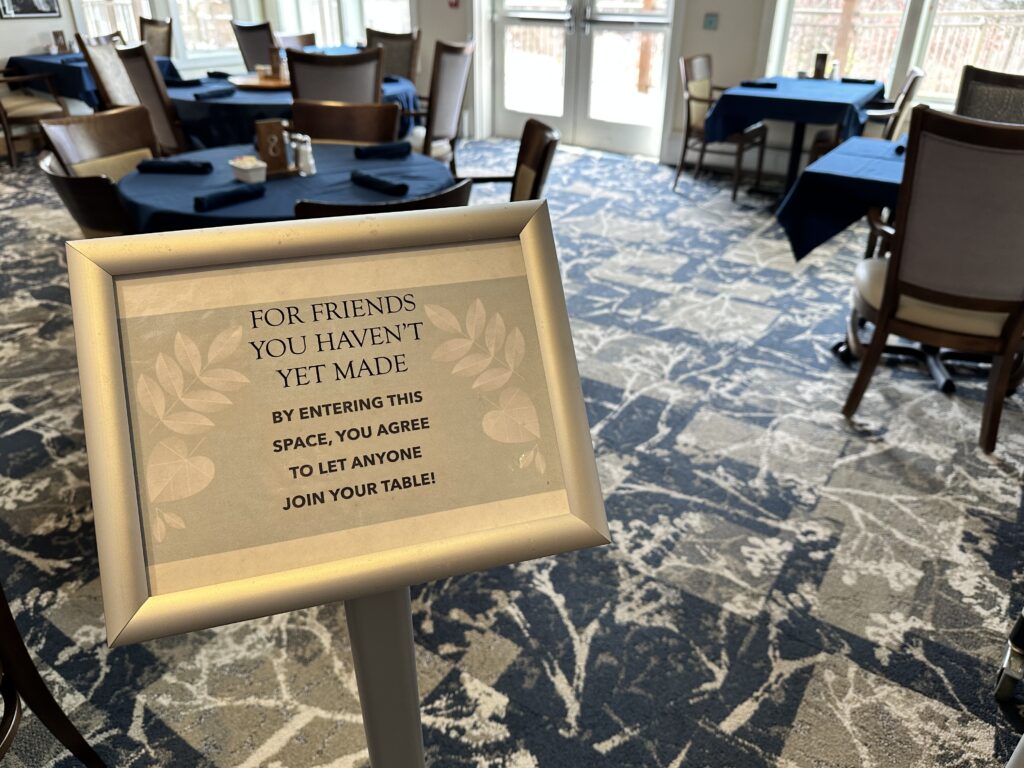
One recent innovation is the Open Seating effort on Thursday nights. Rather than make the usual online reservation, people show up this night ready to sit anywhere in the CafĂ© (the fireplace room) and have dinner with someone new. DAG member Geri A. said, “it’s hard to ask if you can join someone, especially if you are a single.” She and fellow member Bob D. saw a way to change the habit. “At first, we called it The Friend You Haven’t Met, but soon realized that many people actually had met other people, even if they didn’t know them well. Now we are taking a more playful approach and calling it Potluck Seating. The goal is to make it easy to mingle in ways you might not otherwise.”

As Geri and Bob have launched the idea, they would like to take a more backseat approach as individuals become more self-sufficient, seating themselves without oversight. It seems to be a popular idea and we have already seen that this ever-changing group of diners lingers longer on Thursday nights.

Food is an important part of life for all of us. Bob sums it up: “Joining others for events and dining is all a part of the Wake Robin Community, and it’s what sets us out from the rest. We can’t wait to meet you!”

Meet the Power Knot: Composting on Steroids

By | Blog


Executive Chef Bill Lliff adding vegetable scraps to the power knot

We are all more aware of food waste these days and the need for composting rather than adding material to our landfills. When food scraps go to a landfill, the decomposition process produces methane which is much more harmful to the atmosphere than carbon dioxide. This in turn contributes to global warming.

The usual practice of composting places food scraps in a container and saving them until you have a batch to put into your own composter or have it picked up by a trash service. While it’s waiting around, food has a nasty habit of decomposing on its own, creating unpleasant odors and attracting unwanted pests. Then, it has to be moved somewhere else to be used in your garden or hauled away.

At the level of a commercial kitchen, disposing of uneaten food is an ongoing challenge. Wake Robin’s daily meal preparation requires hundreds of pounds of food – fruit salad, green salad, soup, animal protein, plant protein, and more. Some food can be re-purposed, such as using bones and vegetable trim to make flavorful stock. In the end, all unusable food waste becomes compost.


The Power Knot screen


We started looking for an alternative almost two years ago. After much discussion and research by the Climate Action Committee (a group of dedicated Wake Robin residents) and approval from the Town of Shelburne, we committed to purchase a Power Knot biodigester.

A biodigester is an automatic composting machine that disposes of food continuously. Think of it as a stainless-steel stomach in which microorganisms digest organic material. Water is injected into the machine to maintain the correct balance of microorganisms while they rapidly decompose the food waste and send it out as wastewater. A rotating arm inside the biodigester slowly churns the food waste to constantly mix the food, oxygen, and microorganisms. New food can be added at any time and the process continues. The only byproducts are carbon dioxide and water from a natural process that is carbon neutral.

The Power Knot is such a welcome addition to our main kitchen that we also put one in the Linden Health Center. Together, the biodigesters process 400 pounds of compost each week. Reduce, Re-use, and Recycle
you can even do it in the kitchen!

Minimizing the Stress of Moving & Downsizing – a virtual event

By | News
Return of a popular workshop for Priority Depositors!


This online workshop is one that we have offered several times. It seems to be a universal concern, even more so for those who are in the process of moving to Wake Robin.


“Minimizing the Stress of Moving & Downsizing”
a virtual workshop featuring Sarah Thompson, Professional Home Organizer


Whether you are preparing your house for sale or downsizing to a smaller home, Sarah provides suggestions on how to sort through your belongings thoughtfully and fulfill your needs to feel settled and connected to your new home. Her approach to the process is that while acknowledging it can feel like a big job, moving doesn’t have to be stressful!


Sarah helps people transform their space by letting go of clutter, allowing for new possibilities in their life and their home. She believes that everyone deserves a space that feels calm and inspiring and that truly works for your life.


This is a special event for Priority Depositors. If you want to know more about becoming a Priority Depositor, contact the Marketing Office at 802-264-5100 or info@wakerobin.com.

Cleanliness with Accountability

By | Blog

When you do your household cleaning, you probably don’t have anyone following along behind you, checking your work, gathering information, and filing a report. That sounds extreme but if you need to have cleanliness with accountability, you need to have a plan to do that.

At Wake Robin, our practices are very thorough. We have a group of people who set the standards for our housekeeping staff, and they also monitor those activities to be sure we’re meeting them. If you combine a well-rounded cleaning program with a regular audit, you can ensure that nothing falls through the cracks. We call these Cleanliness Audits, and this is how we do them.

The purpose of a cleaning audit is to maintain a clean and hygienic work environment for
staff, residents, and visitors. It helps to guard against infection and reduce the spread of germs and viruses. At the start, Tammy Latreille, Support Services Manager for Environmental Services, and David Mitchell, Quality Assurance Nurse, assessed where we were with our audit practices and what were the expectations. Then they made a plan for improvement.

The team also includes Dawn St. George and Ava Hasani, Support Services Coordinators for Environmental Services. David says he is the support person for the team, collecting the data, while Tammy, Dawn, and Ava are the deciders who determine our standards.

In 2018, we swapped our old pencil and paper system for the digital world of CompuClean, a software suite developed by the Spartan Chemical Company, our supplier of cleaning products. CompuClean records our data on a tablet crunches the numbers, and generates reports that show what we are doing well and which areas need improvement. The program sends an email detailing action items where follow-up is needed. The program is customized for Wake Robin, creating different audits and different schedules.

CompuClean records our data on a tablet crunches the numbers, and we get reports that show what we are doing well and what areas need improvement. The program sends an email detailing action items where follow-up is needed. The program is customized for Wake Robin, creating different audits and different schedules.

We create a task list specific to each space. For example, we’ll start with a random selection of three residences in the Linden Health Center. Add in the chart room, hallway, living room, and shower room. Now we begin the audit: How do the floors look? Is the area dusty? Are the high-touch areas clean? – telephones, door handles, and faucets. The audit team checks surfaces with ultraviolet light which causes bacteria and other materials to fluoresce – they glow in the dark! The usefulness of the audit is in checking something that has recently been cleaned. Some areas are audited monthly, and others are on a quarterly schedule. Our cleaning experts describe this as a continuous cycle: perform the cleaning tasks, do the audit, gather the data, communicate the results, and circle back later.

Another benefit of doing the audits is that besides the cleanliness checks, they also reveal other areas that need attention. Tammy says, “It makes you slow down and look at all the details.” The cleaning staff generate work orders for general maintenance needs they might notice. It might be a paint touch-up or tightening a handle.

David sums it up: “There’s a lot that’s good here. People should feel comfortable that there’s a lot of effort that goes into keeping this place clean. Overall, we do a really good job.”

We often hear visitors to Wake Robin remark on how clean it is. It’s nice to know our cleaning standards, practices, and audits contribute to a safe, welcoming environment.


Trillium Trail at Wake Robin

By | Blog

Last month we told you about a new tradition at Wake Robin called the Trillium Trail. Named after our logo, the red trillium wildflower, it is a variation on the Honor Walk. When a resident is making the final journey out of Wake Robin, a specially designed quilt drapes the person as they leave the building. An announcement is made that a Trillium Trail is about to take place and anyone who wishes to take part gathers near the doorway of the Linden Health Center and forms a line in the hallway to pay their respects, bearing witness to a life and memories.

The newly designed custom quilt was created and constructed in-house by a number of volunteers, both staff and residents. The idea originated with our nursing staff with Morgan Dexter, R.N., and her mother, both accomplished quilters, leading the way. They were joined by Diane T., another quilter and Wake Robin resident, who became the point person for the project, and Jo H., quilter and resident, who donated materials.

The prep work was done in the Fiber Arts room where the experts first selected a color scheme from existing fabric, and then proceeded to the cutting, sewing, and pressing of the initial blocks. Once they had the process nailed down, Diane wrote up the directions, made kits, and put out a call for volunteers under the announcement “Would you like to make a block?” About 35 people came out to take part, some with no sewing experience, but all with a desire to contribute to this project. The final assembly and quilting were completed by Morgan and her mother on a longarm quilting machine.

A lot of hands and minds were involved with the Trillium Trail quilt. It is a nod to our shared human experience, a piece created out of love and respect. It is one more tradition that shapes community life at Wake Robin.